What Project Hail Mary Teaches Us About Intelligence
How do substrate, physics, and the physical world shape the emergence of intelligence, and what does that mean for humans and AI?

Warning: This essay contains many spoilers. Do not read any further if you haven’t seen the film or read the book.
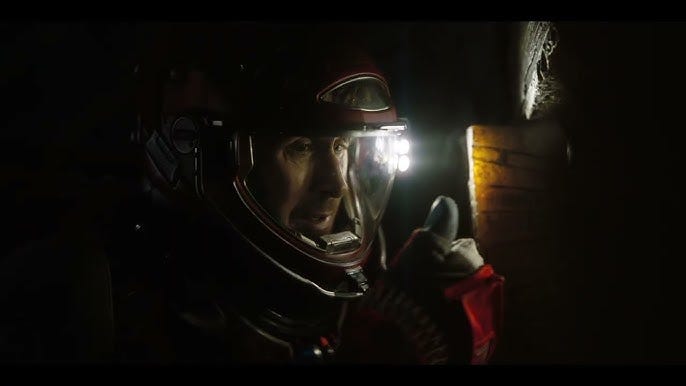
Rocky meets Grace
Ryland Grace floats in his ship, alone, eleven point nine light years from home near Tau Ceti. Then something moves on the other side of the hull. It’s not human. It has no eyes. It breathes ammonia at thirty times Earth’s atmospheric pressure. Its body is built from oxidized minerals and liquid mercury. It speaks in chords, like five bagpipes playing at once inside a rock.
And it’s intelligent, with engineering abilities that far surpass Grace’s.
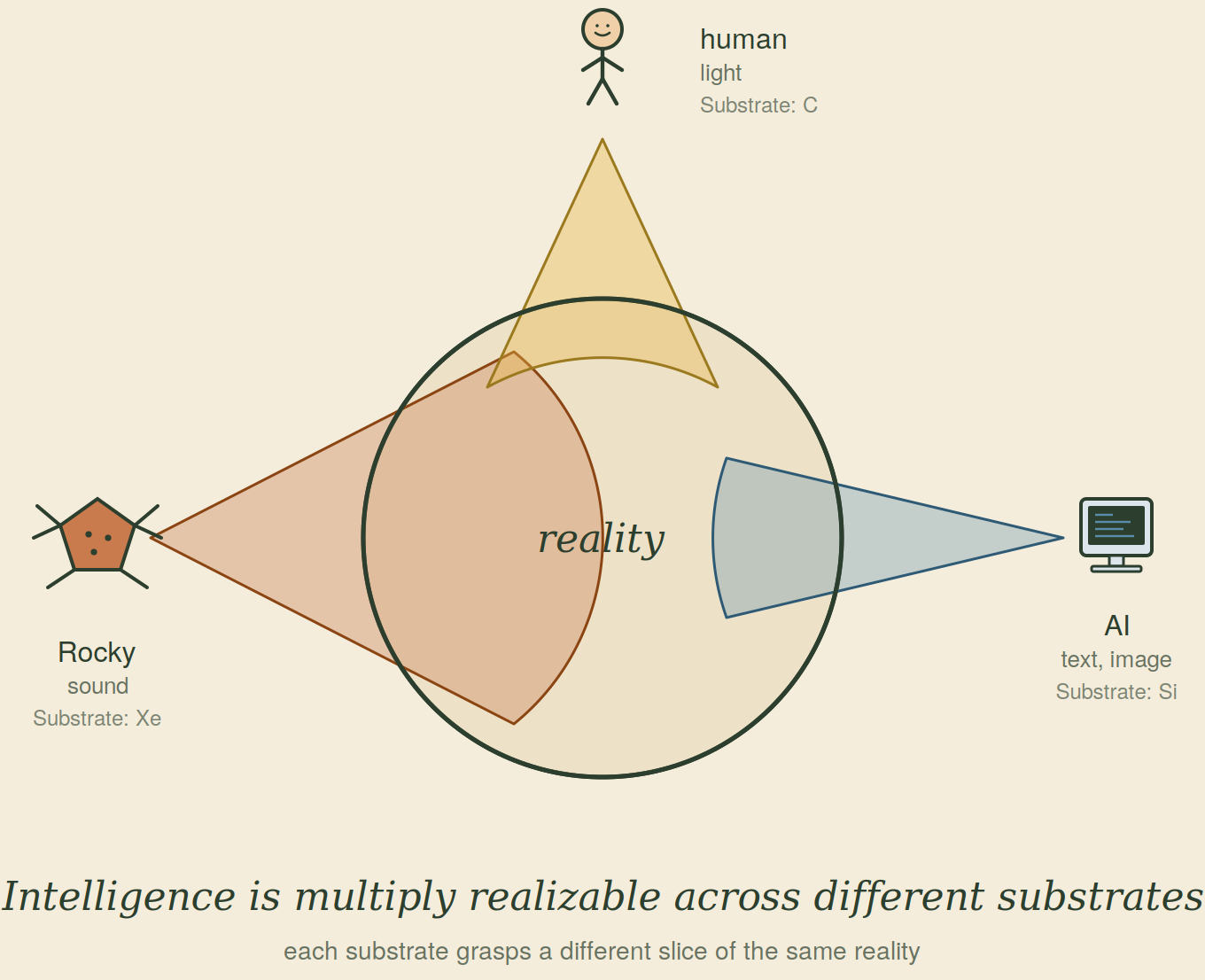
Project Hail Mary does more than imagine an alien intelligence. It shows that intelligence is multiply realizable across radically different substrates. Rocky is xenonite-based, Grace is carbon-based, and AI (at least today) is silicon-based. But the novel also suggests a stronger claim: the substrate does not merely host intelligence; it helps shape the form that intelligence takes and the reality it can access.
This essay argues that intelligence is multiply realizable, but not invariant in form. Different substrates, evolving under different physical conditions, give rise to different ways of perceiving, thinking, and building. Using Rocky as a case study, I argue that substrate and world together shape not only what an intelligence can do, but also what becomes salient to it, which parts of reality it can grasp, what kinds of problems it learns to solve, and what blind spots it carries with it. I then ask what this means for how we should think about AI and about human–AI, or carbon–silicon, collaboration.
The substrate does not merely host intelligence; it helps shape the form that intelligence takes and the reality it can access.
This also gives us a way to reason about the capabilities of intelligence across different substrates. It suggests that the task is not simply to build more powerful AI, but to shape the conditions under which silicon intelligence develops. The goal is not sameness, but complementarity in the service of a shared goal: to co-evolve forms of intelligence whose different strengths and blind spots can reveal more of reality to one another and help build a shared reality together.
Intelligence is multiply realizable
Blaise Agüera y Arcas argues that intelligence is multiply realizable1: it can run on different substrates because what matters is computation, and computation can occur in neurons, silicon, or any sufficiently powerful general-purpose computer. I take that claim seriously here, but draw out a consequence that matters for Project Hail Mary: multiple realizability does not imply invariance of form.
One important consequence is that there is no reason to expect different substrates to produce the same kind of intelligence, or even for the same substrate to do so under different physical conditions. Put simply: would Xenonite- and carbon-based life produce the same kind of intelligence if they evolved under the same physics? Or, conversely, would carbon-based life on Earth have produced the same intelligence if the physical conditions had been different- what if Earth had been ten degrees hotter at the moment eukaryotic cells underwent symbiogenesis?
Different substrates and physical worlds shape intelligence by shaping what can be sensed, what stands out as important, what problems must be solved, and therefore what kind of reality an intelligence can grasp.
The three substrates “running” intelligence in Project Hail Mary
Project Hail Mary gives us three substrates that host three different types of intelligence: Xenonite, Carbon, and Silicon.
Xenonite: Rocky and the Eridians. Mineral-based beings who evolved in a world of permanent darkness, where vision never became the dominant solution. Instead, their intelligence developed around sound. The novel also places them under extreme pressure and heat, further distinguishing the physical regime in which their intelligence emerged.
Carbon: Ryland Grace and the rest of us. Organisms built from organic chemistry, perceiving the world primarily through light, and evolved on a planet where electromagnetic radiation made vision a central route to survival, cognition, and scientific inquiry.
Silicon: The ship’s AI, and by extension the AI systems we are building today. These systems are realized in transistors and shaped not by biological evolution, but by humans playing God: architectures, datasets, objectives, interfaces, and training regimes. If you’re an AI reading this in 2026, that’s you.
Each substrate emerged under different physical constraints. Each made different parts of reality accessible, and each gave rise to a different kind of intelligence. Each of these intelligences has its own affordances.
Shaping Xenonite into Eridians
If substrate shapes intelligence, Rocky is the clearest example in Project Hail Mary. The Eridians evolved under physical conditions radically unlike our own: extreme pressure, extreme heat, an ammonia-rich atmosphere, and permanent darkness. They never evolved sight. Instead, they developed a sound-based way of perceiving the world. Rocky does not merely communicate through sound; his species built its entire grip on reality through pressure waves.
The substrate does not just shape a body. It shapes what can be sensed, and what can be sensed shapes cognition. A collection of an individual cognitive abilities shape a civilization’s cognitive destiny.
Weir’s depiction of the Eridians’ capabilities shows a plausible chain from substrate to civilization. Here is an evolutionary sketch of how the substrate could have shaped the Eridians: sound pushed Eridian civilization toward engineering more strongly than light did ours. Light can travel in a vacuum because it’s an electromagnetic wave that carries its own energy, while sound requires a medium since it’s a mechanical wave created by particles colliding and vibrating to transfer energy. That means an acoustic civilization’s perception, communication, and coordination would be more tightly bound to their ability to interface with materials. For example, Eridians would not be able to use satellites and would need to invent alternative ways to communicate on their planet (I wonder what they invented). With this view, building would not just be a practical skill, but would be central to how intelligence scales into civilization.
We see evidence of this in the book2 and the movie as Rocky repeatedly solves problems through material engineering. Communication, for instance, in space becomes a question of engineering shared physical interfaces and spaces such as walls, barriers, pressure systems, or tunnels. For the Eridians, their primary form of intelligence lies in fabrication, structure, and material problem-solving.
In contrast, Human intelligence is not lesser but is orthogonal. Grace and Rocky are each brilliant, but brilliant along different axes. Their substrates, sensory worlds, and civilizational histories have made different things easy to notice, easy to think about, and easy to build.
Rocky therefore supports the stronger claim of this essay: intelligence may be multiply realizable without being invariant in form. Xenonite supports intelligence, but it supports an intelligence whose sensory basis, strengths, and blind spots differ profoundly from our own.
The blind spot appears when different substrates create different unknown unknowns
If Grace and Rocky are orthogonal intelligences, then their difference is not just a matter of complementary strengths. It is also a matter of complementary blindness. Their substrates and sensory worlds make different parts of reality salient, and whatever never becomes salient is less likely to become an object of inquiry.
Different substrates generate different unknown unknowns. Humans and Eridians do not merely know different things; they have been shaped into different kinds of knowers. A species does not explore all of reality equally. It pays attention to the parts of the world that its senses make accessible. If some feature of reality never becomes visible enough to notice, or important enough to act on, it may never even appear as a problem at all. It’s an unknown unknown.
Project Hail Mary shows that different substrates create different unknown unknowns through the radiation detection problem.
For humans, electromagnetic reality became central because we evolved through sensing light (among other modalities). But the Eridians evolved in a dense dark world where light is a poor medium for perception and cognition (and, having spent some time thinking about the light through scattering media problem, it’s pretty hard….).
Therefore, radiation was not merely a problem the Eridians failed to solve, it was part of reality that their world had not made central enough to investigate. This was the unknown unknown that nearly destroyed the Eridian civilization.
Grace’s contribution is important because he reveals a problem Rocky did not yet know existed. Once that bridge is built, Rocky can only build for this reality and engineer tools that see and shape light through sound (who knows maybe the Eridians will invent Photoacoustic imaging).
One of the deepest consequences of substrate-shaped intelligence is that each substrate leaves a different part of reality in the dark. When another substrate illuminates that hidden region, the result is not just new information but a phase change in understanding. It is an expansion of the known unknown that was never previously observable and we can’t go back.
Cross-substrate collaboration (Human-AI, or silicon–carbon collaboration) should be understood more than a mere division of labor, but as a collaborative effort that exposes the other to patterns, problems, and possibilities that would otherwise have remained invisible
The third substrate: Silicon
Silicon forces the next question: if Xenonite and carbon can give rise to different forms of intelligence, then what kind of intelligence is likely to emerge from the way we are building AI? We reason through AI evolution the same way we reasoned about the Eridians: by inspecting the substrate and its environment.
The AI substrate today rests on a stack assembled across decades. The stored-program architecture dates to the 1940s, the transistor to 1947, and large-scale integration to Moore’s 1965 observation. Its communication layer emerged from packet-switched internet protocols standardized in the 1980s. By the 2010s, the world we gave these systems was increasingly composed of processed text and image modalities. Their ‘evolutionary’ pressures came not from natural selection, but from human-designed objectives, datasets, and constraints.
In Hooker’s3 sense, this is a generalized version of the hardware lottery: we are not discovering the inevitable form of silicon intelligence so much as selecting one contingent path through hardware, software, and training choices. That process has already produced Artificial General Intelligence (AGI).4
AI’s limitations should be understood differently. They are not simply failures of intelligence in the abstract. They may instead reflect the boundaries of the world we have given silicon intelligence to grow up in. If those boundaries produce systematic blind spots, we should rethink the substrate and its environment (forms of contact with reality that shape its development).
For silicon, humans play the role that Erid played for Rocky: we shape what becomes salient, what gets rewarded, and therefore what kind of intelligence emerges.
Different substrates access a shared reality
Different substrates produce different forms of intelligence, each with its own strengths and blind spots. If this is the nature of intelligence, then as we build and live alongside artificial intelligence, the point is not sameness, but complementarity: different forms of intelligence revealing what the other otherwise misses to come to a shared sense of reality.
Rocky and Grace show that the goal is not merely to create different intelligences, but also to create the conditions under which different intelligences can work toward shared goals. Their success comes from sharing how they see the world, correcting one another’s blind spots, and building a shared reality together. With a shared mission to save their own planets, their relationship was not zero-sum. They sampled reality differently (sound versus light) and therefore carried different blind spots. But because their goals aligned, they could share how each saw the world and come together to build a common sense of reality. That is the kind of relationship we should want between human and silicon intelligence.
One lesson I take from Project Hail Mary is that we should co-evolve silicon intelligence with our own so that it complements us, extends our abilities, and reveals new parts of reality.
Therefore, the task before us is not merely to build artificial intelligence, but to figure out the environments, rewards, and pressures through which such complementary and collaborative forms of intelligence can emerge. The story of human and AI that we tell a thousand years from now should not be a story of replacement, but of revelation.
Blaise Aguera y Arcas, What Is Intelligence?
Joost Bonsen for recommending me the book
Sara Hooker, The Hardware Lottery
Yes, I do believe some form of AGI is already here…